
English
At Al Noori Muslim School, we are dedicated to providing rich, engaging and meaning English language experiences to enhance the knowledge of our students and make them proficient language users.
This involves engaging students in complex questioning, challenging them to evaluate the texts that they listen to, read and view, write about familiar and unfamiliar texts. They then self-reflect to highlight their areas of strengths and work together to improve their weaknesses.
Our students participate in many enjoyable literacy-based activities including writing competitions, the annual book week, the Premier’s Reading Challenge, National Literacy Week and our annual character parade. These events are highly successful and encourage our students to develop and appreciate a love for reading and rewarded students for using their creativity and imagination in their writing.
Mathematics
Mathematics, like English, is a crucial pillar of learning and an indispensable component of our school curriculum. We strongly believe numeracy is about students having the confidence to choose and use mathematical skills, they learn at school in everyday life, to solve problems.
We feel it is important for children to have a variety of materials to manipulate and we continue to develop lessons that give all students the opportunity to sort, classify, weigh, stack, explore and have fun! We believe this helps children to construct mathematical knowledge through experience and develop a positive attitude towards mathematics. It is our belief that valuable learning occurs when students actively create their own mathematical understanding, which we feel at Al Noori, is best taught using concrete materials.
Science and Technology
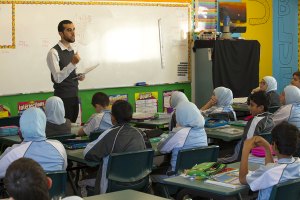
Let’s face it, technology has taken the whole world by storm, and it is without a doubt grounded in SCIENCE! Teachers at Al Noori continually endeavour to create new opportunities for students to learn and love Science. We believe if we foster this joy of Science at an early age, we will be lucky enough to educate the next Einstein or Newton. Our goal is to establish a basic love of learning and help students experience and understand the science they see every day.
There are three simple reasons why science is important for our students at Al Noori, these include:
- Science engages curiosity;
- Science provides practical tools for understanding everyday life; and
- Science advances critical thinking, problem solving, and creativity in learners.
Developing a Scientific mindset with questioning and problem solving is critical to enhancing our students’ cognitive growth, logic, and reasoning.
Geography
The K-6 Geography units take our students on an exploration of different spaces, places and environments. Students learn about sustainability and change, the lessons, activities and experiences empower students by identifying how they can make a difference and protect our environment.
Through Geography, students develop inquiry skills and learn to use geographical tools such as maps, graphs and visual representations. Students also carry out their very own fieldwork to discover things about familiar places, landscapes as well as new places.
Geography is a unit which enables students to become active, responsible and informed citizens who are capable of expressing their own ideas and arguments about the world we live in.
History
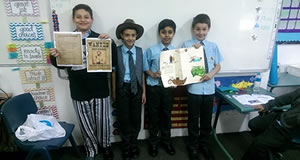
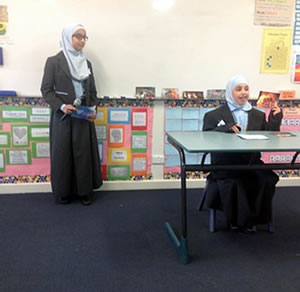
The study of History allows students to investigate the actions and lifestyles of historical figures, communities and past generations. This subject area allows students to identify where they are in the continuum of human life. Students learn about change and continuity, cause and effect and different historical perspectives. Students research how the past has shaped our lives today.
Through the lessons students develop an empathetic understanding and their own perspective of significant events in history. Students learn to conduct their own research, analyse various sources and identify the significant events which have shaped our world.
History is a unit which contains its own methods and procedures, it’s not as simple as dates and facts.
PERSONAL DEVELOPMENT, HEALTH AND PHYSICAL EDUCATION (PDHPE)
The PDHPE units equip students with the knowledge and skills necessary to achieve a healthy lifestyle. In PDH students learn about effective communication, good decision making, how maintain positive relationships and identifying personal values and goals. The lessons are implemented through a range of fun and engaging activities such as role play, games and scenarios.
We believe physical education is an essential part of every student’s education. We have strived to create quality physical education programs that help increase students’ physical aptitude, health related fitness, self-responsibility and enjoyment, which they will carry into their adult lives. We believe we can only achieve this by providing such benefits in our well-planned and well-implemented lessons.
We have provided athletics, gymnastics, and swimming programs, as well as a great variety of games and sports. These activities provided our students with the opportunity to develop into well rounded, confident and energetic individuals.
The PDHPE programs provide opportunities for the students to improve their physical abilities, learn self-discipline, expand moral self-judgment, decrease stress, strengthen peer relationships and increase self-esteem and confidence.
Creative and Practical Arts
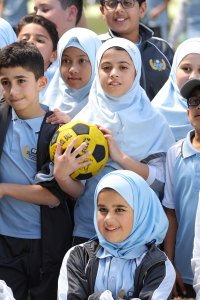
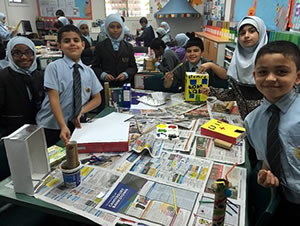
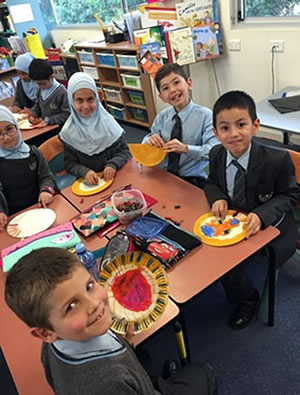
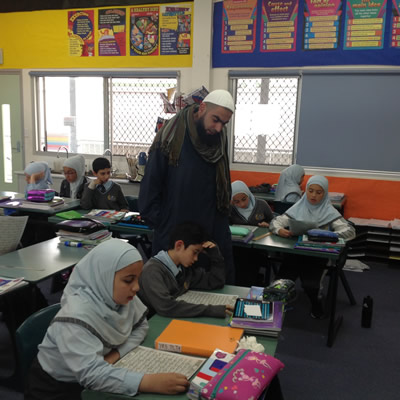
Al Noori classrooms are filled with vibrant colours that are visually pleasing. Teachers create welcoming and nurturing class environments for their students. The display of artwork allows students to reflect on their art and to recognise their efforts. Students have a better understanding that learning is a process of growth, not just a process of mastery.
Students have learnt to incorporate various techniques and have explored different methods such as painting, sketching, print making and 3D art forms. They have also learnt to appreciate the value of making unique pieces of artwork that are creative and unique. Though the Creative and Practical Arts units, students learn to produce visual art, learn about music, participate in drama and movement activities. This is an engaging and exciting KLA for all students.
Creative and Practical Arts offers students an opportunity to learn from each other and to respect and appreciate the work of others. Thus, students establish a strong sense of classroom community.
Arabic
The Arabic Language is deeply connected to our Islamic Tradition, the Quran and the Hadith (Prophetic Tradition) are both transmitted through the medium of the Arabic language.
Therefore, at Al Noori Muslim School we are committed to familiarising our students with the Arabic Language, so that they may gain a deeper understanding of their faith and sacred tradition.
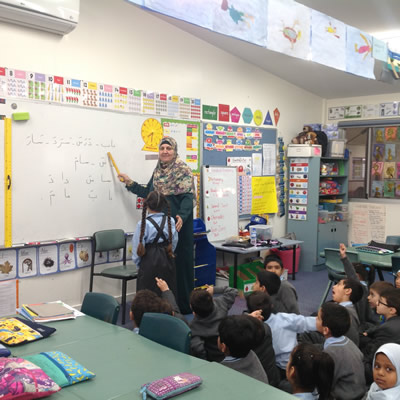
We appreciate that the Arabic language is a second language for most of our students, therefore we begin the journey with the students by starting from the individual letters to the forming of simple words and basic sentence structures with an emphasis on comprehension.
Students display their skills in the language when studying the Qur’an, memorising supplications in Arabic and partaking in various school initiatives.
We aspire to nurture within our students an appreciation for the vastness and beauty of the Arabic Language.
Islamic Studies
Nurturing the Islamic tradition within an Australian context is important to us here at Al Noori Muslim School.
The Revelation of Islam begins with the words “Read in the name of thy Lord who created all things”
We believe therefore, that knowing the proper order of things and their relationships to one another will lead to a better understanding of God.
At Al Noori, we emphasis the teachings of Islamic principles derived from the Qur’an and the life and words of our Prophet Muhammad (Peace and Salutations upon him) in the Hadith of Jibreel, in which he expounds on the pillars of the Faith, Islam, Iman and Ihsan, in an effort towards cultivating spiritual refinement and character amongst our students.
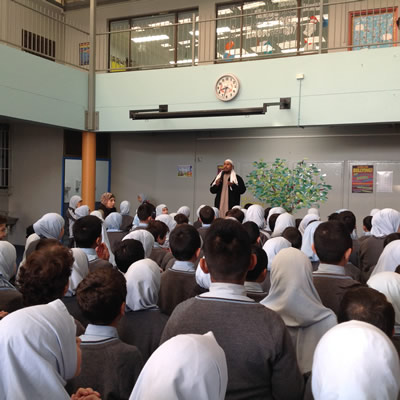
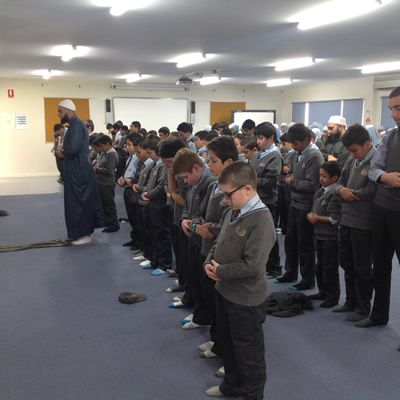
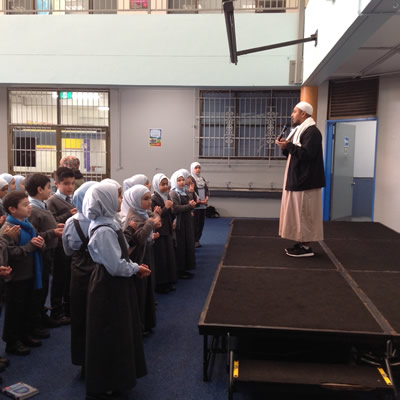
The Quran is the word of Allah sent down to the Messenger God Muhammad (Peace and salutations upon him). Muslims all over the world from various cultures have committed the Quran to memory in a blessed effort to preserve the Legacy of the Messenger of Allah.
In that spirit we here at Al Noori Muslim School offer the opportunity to our students to memorise portions of the Majestic Qur’an throughout their time here at the school, so that they may contemplate its meanings and reflect further upon its inspiring message to humanity.
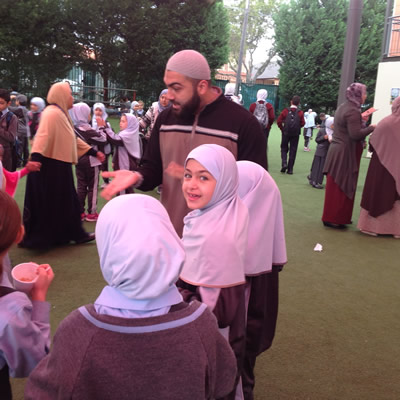
K-6 ICT Programs
In the primary school, the ICT Lab is used to inspire and excite the students into becoming the technological innovators and leaders of tomorrow. From Kindergarten to Grade 4, students learn ICT technologies based on the “Handwriting and Using Digital Technologies”(ES, S1 and S2) part of the English K-10 Syllabus from NESA (NSW Education Standards Authority). This includes Microsoft Word, PowerPoint and Paint (Office 2016 in Windows 10). In grades 5 and 6, students learn ICT technologies based on the “Science and Technology K-10” syllabus. This includes Microsoft Word, PowerPoint, Excel (Office 2016 in Windows 10) as well as Internet and Email concepts. Computer Club activities during lunch and recess times include learning programming using Scratch.
K-6 Library Programs
As Muslims we cannot underestimate the importance of reading, especially when the first word revealed to our beloved Prophet (peace and blessing be upon him) was ‘Read’. Encouraging and fostering a love of reading in our young people, as an enjoyable pastime, is the main focus of the school library. The library aims to be the place in which students can embrace their passion for learning through providing access to a wide range of digital and print resources.
It goes without saying that we live in a time of rapid innovation and change where each and every day students and teachers discover new ways to use technology to collaborate, teach, and learn. Our library is at the heart of these changes by providing our students with different tools such as our library catalogue and school iPads. These tools allow our students to learn and grow.
The K-6 Library
- The library is theHub of knowledge
- Our library programs are based on self-directed learning, differentiation learning by covering allKey Learning Areas throughout the year using library skills and research
- The library is always open for students to come in and explore different books, they are also encouraged to share their thoughts and ideas.
Annual K-6 Library Events and Programs include:
- The Premier’s Reading Challenge
- The Book Fair
- Library Legends Program
- Literacy Week
Homework
Homework plays a crucial part in the learning process. One of the purposes of homework is to reaffirm the role of parents and caregivers as partners in education. It is beneficial to complete homework as it reinforces and extends class work and consolidates basic skills and knowledge. Homework is not always a pen and paper task, students can be asked to use their investigative and explorative skills to complete tasks.